01overview
Every overcollateralized lending market — Aave, Morpho, Spark, and the margin engines behind perpetual DEXes like Hyperliquid — has the same problem: when a borrower's collateral falls too close to their debt, someone has to step in, repay that debt, and take the collateral off the protocol's books before it becomes a bad debt the protocol eats. Protocols can't do this themselves, so they pay an outside party to do it. That payment is a fixed discount on the seized collateral.
REAP is the outside party, pooled. Instead of a single searcher running private infrastructure to win those liquidations, depositors pool USDC into a vault that bids them collectively and splits the proceeds pro-rata. You are not lending and earning interest. You are holding a claim on a stream of liquidation discounts.
02the discount
A borrower's position is healthy while the value of their collateral, marked down by a protocol-set risk factor, still covers their debt. That ratio is the health factor:
When price moves push HF to 1 or below, the position is open for liquidation. A liquidator repays some of the debt and, in exchange, receives collateral worth more than what they repaid — the extra is the liquidation bonus (also called the incentive or penalty). The bonus is the protocol's price for getting the bad debt cleared quickly; it is set in advance and is the same whether the liquidator is a bot or a vault.
The discount is not a market inefficiency that will be arbitraged away. It is a permanent, protocol-funded incentive — the system is designed to overpay for liquidation so that solvency is never at risk. As long as people borrow against volatile collateral, the discount is being printed.
03the capture loop
When the vault wins a liquidation it does four things in one transaction: repay a portion of the debt, receive the collateral at the bonus, and then unwind that collateral back to USDC. The gross profit is just the bonus applied to the debt the vault clears:

That number is gross, not realized. Two costs sit between the seized collateral and a USDC balance the vault can show: the price impact of selling the collateral (large seizures move the market against you), and the gas to land the transaction. Net of those:
The unwind term is why size and liquidity matter more than headline bonus: a 10% bonus on an illiquid asset can net less than a 5% bonus on something with deep markets. REAP routes the unwind across venues to keep s low, which is most of the edge over a naive liquidator.
04where returns come from
Across all the venues the vault monitors, some notional amount of collateral gets liquidated over any period. The vault doesn't win all of it — it competes with independent searchers and other vaults — so it captures a fraction at the average bonus, after costs:

Divide revenue by the capital backing it and you get the depositor's return for the period:
This is the whole thesis in one line. Return scales with liquidation volume V and the vault's win rate w — not with a borrow-lend spread, not with an emissions schedule, not with anything that drips evenly. There is no yield when nothing is being liquidated.
05why returns are lumpy
The term that drives everything, V, is not steady. A position only liquidates when a price move is large enough to push its health factor through 1. Rearranging the condition from section 02, a long position is liquidated once the collateral price falls by roughly
HF = 1. Highly leveraged positions sit at a small \(\Delta^{*}\); they liquidate on minor moves.On a quiet day, almost nothing crosses its Δ*, so V ≈ 0 and revenue is near zero. In a deleveraging cascade, a sharp move liquidates a band of positions at once, those forced sales push prices further, which trips the next band — and V spikes by orders of magnitude in hours. Revenue tracks realized volatility, and volatility arrives in bursts.
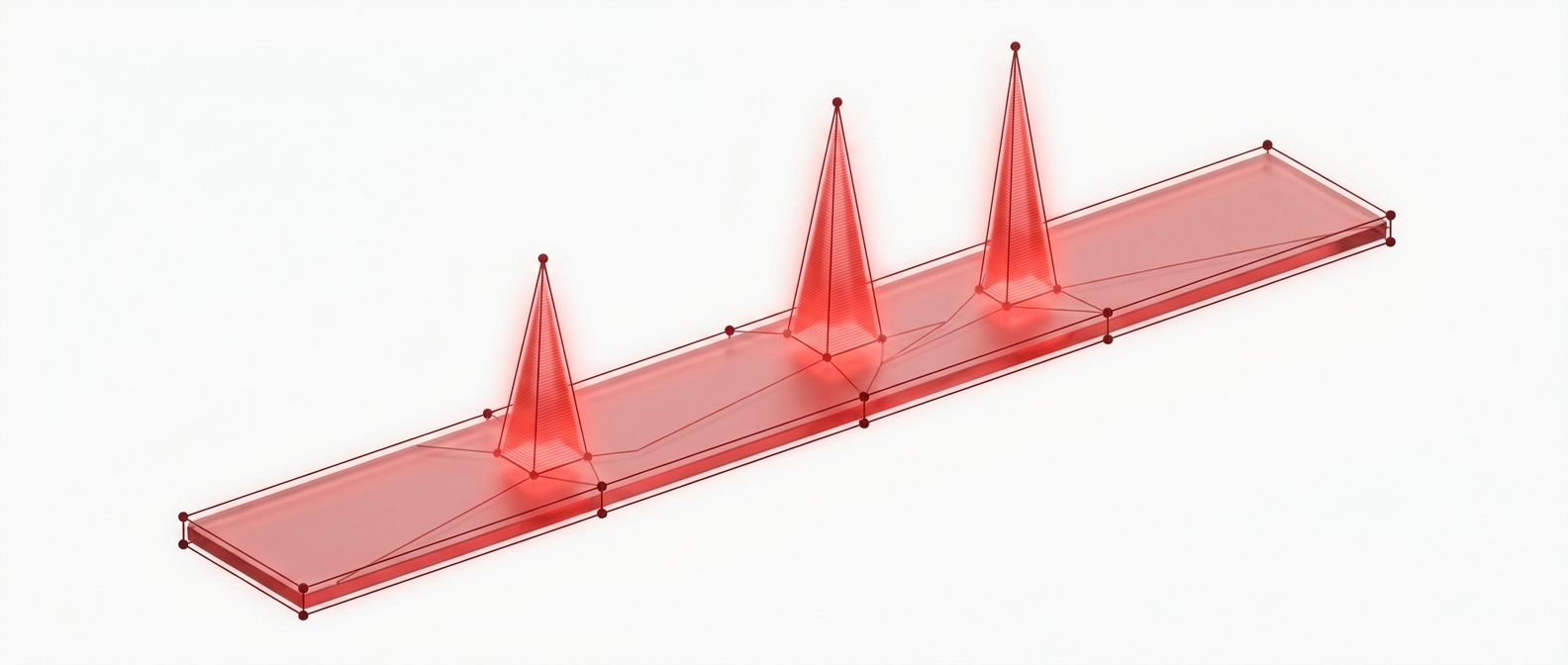
A vault share is closer to a long-volatility position than to a savings product. It earns little, or nothing, through calm markets and prints during the exact events — crashes, liquidation cascades — when most of the market is losing money. Sizing a deposit should account for that payoff shape, not an assumed steady APR.
06why the lock-up exists
To win a liquidation you need USDC available at the instant it happens. The vault can only deploy what's sitting in the book, so the amount it can capture in any window is bounded by its deployable capital:
The problem is timing. Volatility is exactly when Lavail is largest and when nervous depositors most want to pull funds. If withdrawals were instant, the book would drain at the precise moment the opportunity appears, collapsing K and forfeiting the capture. A 4-day withdrawal queue decouples the two: it holds K stable through a cascade so the vault can keep bidding while everyone else is panicking. The lock-up isn't a convenience tax — it's what makes the strategy investable at size.
07the exit hook
The four day queue protects the book, but a hard wait is a real cost to depositors. REAP softens it with a second door, built on a Uniswap V4 pool. The slow path still redeems shares at full value through the queue. The fast path lets you sell vault shares straight into the pool and leave in the same block, at the value of your shares minus a fee that rises with how stressed the book is.
The pool pairs the vault share token against USDC, and the vault is its own market maker: it supplies the liquidity itself, concentrated in a tight band around net asset value (NAV). Because the vault owns that position, every fee paid by someone leaving early flows straight back into the vault and lifts NAV for the depositors who stay. Leavers pay stayers, with no extra plumbing.
The fee on the fast exit is not fixed. It is built from three live signals: how much capital has already left in the current window, how much of the book is still liquid, and current realized volatility.
In calm markets the fee stays near the floor, so leaving is cheap and the vault earns a steady trickle of pool fees that softens the lumpiness described above. In a cascade the fee climbs hard, because that is exactly when the vault's USDC is most valuable for bidding and when the depositors who hold steady deserve to be paid by the ones who run. The same idea that drives the vault, value flowing toward whoever stays through the chaos, now runs the exit door too.
The fast door is capped. Only a limited amount of capital can leave through the pool in any window; past that, the queue is the only way out. A rush can never drain the book faster than the strategy can survive, and the cap itself is a dial between the instant liquidity the vault offers and the USDC it keeps free to bid.
Full value is always available through the queue. The pool price is the price of immediacy, not a discount on what you own, and it can sit below NAV when many people want out at once. The fast door depends on collateral being marked conservatively, so the vault values what it holds with a haircut and a slow, manipulation resistant feed. Instant liquidity also means some USDC rests in the pool instead of out bidding liquidations, a deliberate cost paid for the convenience.
08the buyback
A fixed slice of every realized capture is routed to buy the REAP token on the open market, \( \text{buyback} = \varphi \, R \), where φ is the protocol's buyback share of net revenue. The buyback is funded only by actual realized discount, so it has the same lumpy, volatility-linked shape as everything else — it is a function of R, not of token emissions or a fixed schedule.
09parameters
The symbols above split into two groups: protocol constants the vault sets, and market quantities it can only measure. Live measured values are shown as n/a here and reported on the vault dashboard when data is available.
| symbol | meaning | value |
|---|---|---|
| L | withdrawal queue / lock-up window | 4 days |
| fexit | instant exit fee via the V4 pool, scales with stress | n/a |
| cap | max capital that can take the instant exit per window | n/a |
| φ | share of net revenue routed to buyback | n/a |
| b̄ | average liquidation bonus captured | n/a |
| w | win rate vs. other liquidators | n/a |
| η | net efficiency after slippage & gas | n/a |
| V | liquidation notional, monitored venues | n/a |
| ρ | trailing realized return | n/a |
10assumptions & risks
The model is only as good as its terms hold up. The honest failure modes:
- Win rate is not guaranteed. Liquidations are competitive. Well-capitalized searchers with private orderflow can outbid the vault, driving
w— and therefore returns — lower than the mechanism allows in principle. - Slippage scales with size. As TVL grows, each unwind is larger relative to available liquidity, raising
sand loweringη. The strategy has a capacity ceiling; more capital does not mean proportionally more return. - Long flat stretches. Calm markets can mean near-zero revenue for weeks or months. The payoff is real but irregular; there is no contractual yield.
- Smart-contract and oracle risk. The vault interacts with external lending markets and price feeds. A bug, an oracle failure, or a venue exploit can cause loss independent of the strategy working.
- Bad debt. In a violent enough move, seized collateral can be worth less than the debt repaid by the time it unwinds — a liquidation can lose money, not make it.
- Instant exit adverse selection. The fast door is most tempting when collateral is briefly worth less than a lagging NAV suggests. Conservative marks, a slow price feed, and the stress fee defend against it, but a large enough mark error can let early leavers exit richer than they should, at the expense of the depositors who stay.
None of this is a reason the mechanism doesn't work; it's the set of things that determine how well it works. Read it before sizing a position.